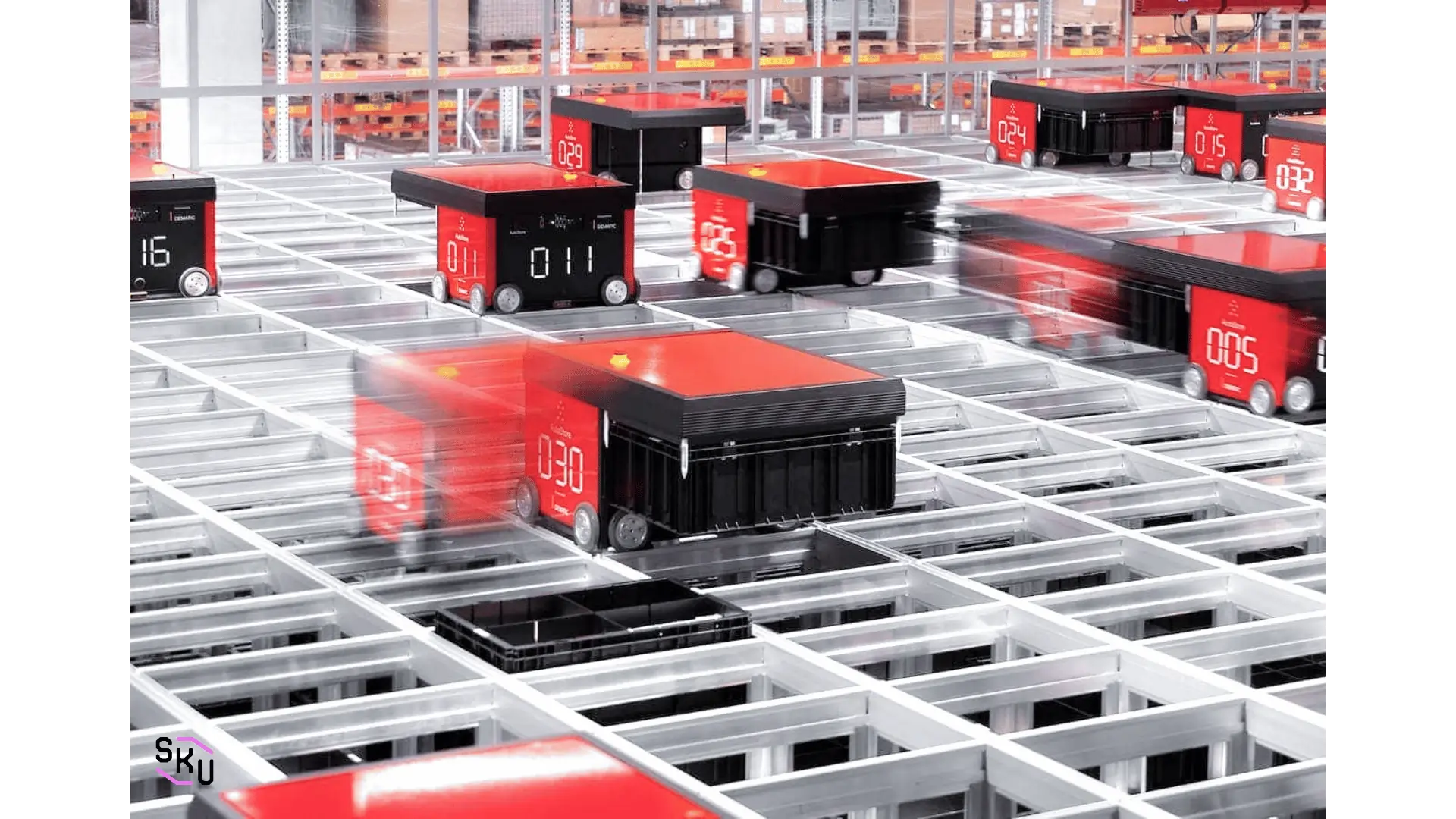
As the demand for faster delivery times and flawless service in the eCommerce space continues to rise, brands today must meet increasingly higher standards for order fulfilment.
With 61% of global consumers choosing to continue shopping with brands that can provide their goods the fastest, it’s not enough for businesses to get their products into the hands of customers – they must do so with precision and speed.
To keep up with these customer demands, warehouse automation has moved from a nice-to-have to a competitive necessity. Nowhere is that shift more visible than in the rise of warehouse robotics, the technology now reshaping warehouse operations from the moment stock arrives to the moment it leaves the building. If you'd like to see how this technology applies to your specific business model, explore our full range of Robotic Order Fulfilment Solutions.
Enter robotic order fulfilment.
What is Robotic Fulfilment?
Robotic fulfilment refers to the use of automated systems to sort, pick, pack, and ship orders within a warehouse environment. These systems integrate sophisticated software and advanced technology to carry out tasks traditionally performed by human workers. These systems integrate sophisticated control software and advanced technology to carry out tasks traditionally performed by human workers.
But what makes these systems so revolutionary?
While traditional order fulfilment methods often involve manual picking, packing, and shipping processes prone to human error, robotic fulfilment is designed to process orders with a high degree of accuracy and consistency. Where older, fixed systems could only perform one task in one place, today's warehouse robots are flexible enough to be redeployed as demand shifts.

The result? Mispicks, incorrect quantities, shipping delays, and the error rates associated with manual handling are significantly reduced by robotic fulfilment systems. This ensures that every order is picked and packed accurately and processed with robotic efficiency.
Warehouse robots can also operate 24/7, providing a level of productivity that far exceeds that of a human workforce alone. As a result, businesses are capable of handling higher order volumes and meeting tighter shipping deadlines even during peak times, without the operational strain that comes from relying on human labour to absorb every spike in demand.
Understanding the Technology in Robotic Fulfilment Centres
In robotic fulfilment centres, several distinct categories of warehouse robotics work together to automate the order fulfilment process. Below are the most common types of robotic equipment you'll find in these facilities.
Automated Guided Vehicles (AGVs) and Autonomous Mobile Robots (AMRs)
Automated Guided Vehicles (AGVs) are mobile robots designed to transport goods and materials within the fulfilment centre, typically following fixed paths such as embedded wires or magnetic strips. Autonomous mobile robots go a step further: using advanced sensors and computer vision, these robots can navigate dynamically around obstacles and people on the warehouse floor rather than following a predetermined route.
This is one of the clearest illustrations of how far warehouse robotics has come. Where AGVs need a layout built specifically around their fixed paths, autonomous mobile robots adapt to the space as it already exists, making them far easier to introduce without a full facility redesign. For a closer look at the specific machines behind this shift, see our guide to automated warehouse robots.
Robotic Arms and Goods-to-Person Systems
Robotic arms are another type of robotics technology commonly used to perform tasks such as picking and packing products precisely. Fitted with computer vision and advanced sensors, a robotic arm can scan barcodes or weigh products, which helps reduce the risk of errors per product delivery.
Many modern warehouse robots now operate on a goods-to-person model, in which automated storage and retrieval systems bring inventory directly to a human operator or robotic picking station, rather than having a person walk the floor to retrieve every item. This goods-to-person approach, popularised at scale by Amazon Robotics, dramatically cuts the walking time that once ate up a large share of a picker's shift.
Robotic fulfilment centres also utilise conveyor belts, sorting systems, and other automated equipment to further streamline the fulfilment process. By combining AGVs, AMRs, robotic arms, and automated storage systems, businesses can create a fully integrated system that handles the entire fulfilment process from start to finish.
For example, AGVs and AMRs handle transporting inventory from a storage location to packing stations, while robotic arms pick and pack products with a high level of accuracy - working together to optimise the flow of goods through the fulfilment centre.
Reading all this and wondering what it actually looks like in practice?
Our Third-Party Logistics Provider 3PL runs on exactly this kind of robotics-powered infrastructure. Boost Lab plugged into it and scaled processing capacity 5x while cutting fulfilment costs by 50%. Explore our Sydney and Melbourne fulfilment centres. Call us now - (02) 9090 4747
The Software Behind the Robots: AI, Machine Learning, and Data
Warehouse robotics isn't just about the physical machines on the warehouse floor - it's the intelligent software running underneath that makes them useful. Artificial intelligence and machine learning power the decision-making that tells a robot which item to retrieve next, which storage location to use, and how to route around congestion in real time.
Machine learning models trained on historical order data also feed into inventory management, helping predict which SKUs need to sit closest to packing stations during peak periods. Layered with data analytics from every pick, pack, and dispatch, these systems continuously refine themselves, applying advanced algorithms to make each shift more efficient than the last. This is where artificial intelligence earns its keep in the modern warehouse: not by replacing human judgment, but by feeding better information into it.
Do Robots Replace Workers? Collaborative Robots and Workplace Safety
One of the most common questions brands ask about warehouse automation is whether it will replace workers outright. In practice, the more common model is collaborative robots - often called cobots -working alongside people rather than instead of them.
Robots are typically deployed to take on repetitive tasks and physically demanding tasks: heavy lifting, constant walking, and repetitive work that contributes to fatigue and injury over a long shift. By automating these physically demanding parts of the job, warehouses can meaningfully improve workplace safety, reducing the physical demands placed on warehouse workers while freeing up human labour for more complex tasks that still require judgment - quality checks, exception handling, and customer-specific packing requirements.
This distinction matters, especially against the backdrop of ongoing labour shortages across the logistics industry. Rather than a straightforward story of automation technology displacing human labour, the more accurate picture is one of warehouse workers and industrial robots dividing the work according to what each does best: robots excel at speed, consistency, and repetitive tasks, while people excel at the more complex tasks automation still can't fully handle.
Amazon Robotics: The Industry Benchmark
No conversation about warehouse robotics is complete without Amazon Robotics, the division that's arguably done more than any other single company to popularise robotic fulfilment at scale. Amazon Robotics pioneered the goods-to-person model across its distribution centres, deploying tens of thousands of mobile robots that bring shelving units directly to human operators rather than sending pickers on foot through the warehouse.
The scale of Amazon Robotics' rollout has pushed the entire industry forward - smaller and mid-sized 3PLs now expect the same class of technology that Amazon Robotics made mainstream, from automated storage and retrieval systems to intelligent software that orchestrates thousands of robots without collisions. What used to be exclusive to the largest distribution centres in the world is now accessible to growing eCommerce brands through specialist fulfilment partners.
.jpg)
5 Advantages of Robotic Order Fulfilment for eCommerce Businesses
For eCommerce operators, transitioning to robotic fulfilment systems is not just a step forward but a giant leap in enhancing order fulfilment operations. Here’s why:
1. Reduced Operational Costs
By automating tasks that would otherwise require human intervention, businesses can reduce the need for manual labour, which can help lower labour costs.
Robotics technology integrated into an eCommerce shipping platform can work around the clock, without the need for breaks or rest, significantly increasing the productivity of the fulfilment centre. This means that businesses can process more orders in less time, which can be especially beneficial during peak seasons when demand for products is high.
2. Scalability
Traditional fulfilment operations often struggle to scale up efficiently, as they require significant investments in recruitment, training, and management of temporary or additional workforce. This can lead to increased costs and potential delays, especially during high-demand periods. Robotic systems, on the other hand, can quickly adapt to changing requirements without the need to hire and train additional staff, whether during a seasonal peak or unexpected surge in demand. With 64% of leaders saying their business is unable to deliver on what they believe customers expect during peak times, the flexibility and scalability of robotic fulfilment centres allow brands to maintain optimal performance levels and meet customer expectations, regardless of demand fluctuations.
3. Space Efficiency
Robots, designed for optimal movement and storage, make better use of warehouse space, accommodating more inventory and enabling businesses to operate from smaller, more cost-effective locations. SKUTOPIA, the first urban micro-fulfilment in Australia, perfectly encapsulates what this could mean for eCommerce businesses. Not only does our space enable sustainable eCommerce operations, but our location also allows us to ship orders fast in Australia's metro areas and the broader areas with speed.
4. Accuracy
For every return, businesses spend approximately 66% of the product’s original price. However, the cost of order inaccuracy extends beyond financial losses. It can also damage brand reputation, resulting in lost sales and diminished customer loyalty. Fulfilment robotics offers a solution by significantly enhancing order accuracy. These systems are programmed to perform tasks with accuracy, reducing the risk of errors such as incorrect order fulfilment, damaged products, or inaccurate inventory counts. By minimising errors, companies can reduce the incidence of costly returns and refunds, ultimately fostering a more reliable and positive customer experience.
5. Speed
Lastly, robotic fulfilment centres have faster order processing times. By automating tasks such as product picking and packing, businesses can process orders more quickly and efficiently. According to Forrester, customers now expect delivery of their products within 2-3 days. By 2029, same-day and next-day delivery will be the new standard. Fulfilment robotics enables brands to meet these expectations seamlessly, ensuring they remain competitive and capable of delivering rapid, reliable service to their customers.
Picking, packing, and shipping accurately at volume is the whole point of robotic fulfilment
Whether you're shipping B2B wholesale orders, B2C direct to customers, or both, our Pick and Pack Solutions are built on the same robotics stack covered above. tbh Skincare scaled to 1M+ units shipped with a 20x increase in daily orders using this exact system. Call us now - (02) 9090 4747
Fixed Automation vs. Flexible Warehouse Robotics
It's worth drawing a line between older, single-purpose systems and the more flexible warehouse robotics available today. Conveyor lines and sortation equipment bolted to a specific configuration deliver strong throughput but can't easily adapt once installed. If your storage needs change, or your supply chain shifts to different product mixes, fixed infrastructure often means an expensive retrofit.
Modern warehouse robots avoid this trap. Autonomous mobile robots, in particular, can be reprogrammed and redeployed as a business grows, integrating with existing systems rather than replacing them wholesale. For eCommerce brands that don't yet operate at Amazon Robotics scale, this flexibility is often the deciding factor: it lets a growing supply chain scale its automation technology gradually, rather than betting everything on one fixed configuration from day one.
Why Companies Are Investing in Warehouse Robotics
Companies investing in robotic fulfilment today are responding to a supply chain environment defined by rising customer expectations, tightening margins, and persistent labour shortages. The trajectory for warehouse robotics is steeply upward, and businesses that embrace these technologies now are positioning themselves for success later.
Transforming your order fulfilment process with robotics isn't just an operational change - it's a commitment to adapt and grow in an ever-evolving marketplace. For eCommerce brands weighing up the investment, the return typically shows up across three areas: lower operating costs, improved customer satisfaction, and far tighter control over inventory than manual counting ever allowed. For the time-saving side of this equation specifically, see how automated fulfilment can save your brand time. And if you want a broader sense of where the industry is headed next, our piece on the future of order fulfilment covers the predictions and trends worth watching.
Robotics only pays off if the software behind it is just as sharp.
Our Cloud Fulfilment platform and Inventory Forecasting tools turn the real-time data these robots generate into decisions you can act on. Babyboo grew order volume 77% while holding a 99.9% same-day dispatch rate on this exact combination. Call us now - (02) 9090 4747
The Rise of Robotics Fulfilment Centres
.jpg)
As eCommerce continues to expand, the need for faster, more reliable, and cost-effective fulfilment solutions will become even more urgent. The trajectory for robotic fulfilment is steeply upward, and businesses that embrace these technologies today are positioning themselves for success tomorrow.
Transforming your order fulfilment process with robotics isn't just an operational change - it's a commitment to adapt and grow in an ever-evolving marketplace.
We at SKUTOPIA are at the forefront of this revolution, employing the latest in fulfilment robotics to ensure your business stays ahead. As innovators in the logistics industry, we believe in a forward-thinking mindset, enabling businesses to align with future trends and buyer preferences.
For us, fulfilment robotics is not just about cutting costs – it's about elevating your brand's value proposition in a crowded online marketplace.
Ready to be at the forefront of logistics innovation? Partner with SKUTOPIA today.

Fariha Shuvakhana
Fariha Shuvakhana is the Chief Growth Officer at SKUTOPIA, a 3PL fulfilment and shipping platform for fast‑growing eCommerce businesses. Fariha focuses on sustainable, customer‑first growth - aligning go‑to‑market strategy with operational efficiency and partner‑led expansion.