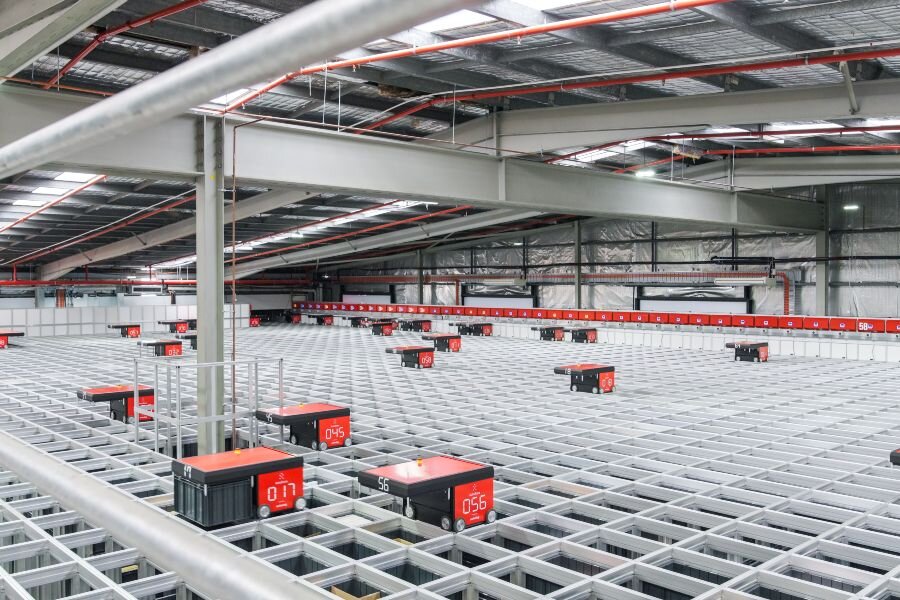
For ecommerce merchants selling across more than one channel, distributed order management (DOM) is the system that decides, in real time, which location should fulfil each order so it arrives fast and cheaply. Think of it as the brain above your warehouses, stores and suppliers. It routes every order to the smartest fulfilment location, instead of one default spot.
Here is why that matters. A shopper buys on Shopify. The same stock is listed on Amazon. Your inventory sits in two warehouses and maybe a retail store. Who ships the order? From where? By which carrier? Get it wrong, and you oversell, split one parcel into three, or pay for express freight across the country. Get it right, and margins hold while customers stay happy.
This guide explains what distributed order management is, how a distributed order management system works, why ecommerce merchants need it, and how to tell if you do. We will keep it plain, and we will keep the jargon honest.
A quick note on spelling. We use British "fulfilment" throughout this guide. Global software and search often use the US spelling "fulfillment", and the two mean the same thing. So when international platforms talk about order fulfillment, ecommerce fulfillment, fulfillment optimization, picking the right fulfillment location, or routing stock across fulfillment centers, they are describing exactly what this article covers.
What is distributed order management (DOM)?
Distributed order management is an approach to order fulfilment that uses rule-based logic to decide where and how each order is fulfilled across a network of locations. Rather than pulling every order from one warehouse, a DOM system looks at your whole network- warehouses, fulfilment centres, retail stores and suppliers- then picks the best source for that order.
Gartner calls this order orchestration: coordinating inventory, sourcing and delivery decisions across the fulfilment network. Microsoft frames DOM the same way. It is a rules engine that automates sourcing and routing, so no one has to decide order by order.
The core idea is simple. One view of all your stock. One set of rules about cost, speed and location. Every order routed automatically to the option that fits best.
For merchants exploring smarter order routing, our guide to 3PL, 3PL Australia solutions and order orchestration platform provides more context on how these capabilities work together.
Distributed order management vs a traditional order management system (OMS)
A traditional order management system records and processes orders. A distributed order management system goes further. It decides, dynamically, which node in the network should fulfil each order to balance speed and cost.
Put simply, every DOM is a form of order management. But not every order management system does distributed routing. Standard order management software just records and processes orders. Distributed order management software goes further, adding smart routing on top. With DOM, you get faster order processing and fewer manual errors. It is the upgrade that kicks in once your inventory and your customers are spread out.
DOM vs WMS vs ERP: where a DOM system fits
These four get muddled constantly. So let us keep them separate:
- WMS (warehouse management system): runs operations inside one building. Picking, packing, put-away, stock locations.
- ERP (enterprise resource planning): runs the business. Finance, procurement, HR and reporting.
- OMS (order management system): handles the order lifecycle, from checkout to delivery.
- DOM (distributed order management): sits across the network. It decides which location fulfils each order, then hands the job to the WMS at that site.
So a DOM system does not replace your WMS or ERP. It coordinates above them. The WMS executes. The ERP accounts. DOM decides who does what. Unlike warehouse management systems that each run a single site, a DOM system reasons across the whole network.
How does a distributed order management system work?
A distributed order management system works in five steps: promise, allocate, source, ship and return. Each step uses real-time data to make a call a human could not make fast enough by hand. Walk through a single order, and it clicks into place.
Promise: accurate delivery dates from real-time inventory visibility
First, the system promises a realistic delivery date before checkout. It can only do this with real-time inventory visibility: a live count of what is available across every location. That inventory status updates the moment orders flow in.
Guess here, and you break trust. A DOM system reads live stock across the network, so the delivery dates shown at checkout reflect what you can actually ship. Those dates are really customer promises. Getting them right protects trust and cuts support tickets. No overselling a line that sold out two minutes ago on another channel.
Allocate: order routing to the best fulfilment location
Next, the system allocates the order. This is the heart of DOM. Order routing picks the best fulfilment location based on the rules you set, closeness to the customer, available stock and cost to serve.
Nearest node with stock? Cheapest route? Fastest dispatch? You set the priority. The engine applies it to every order, every time, with no spreadsheets and no manual data entry.
Source: inventory sourcing across fulfilment centres and sales channels
Then comes inventory sourcing. If no single location can fill the whole order, the system decides whether to split the shipment across fulfilment centres or hold and consolidate it. It weighs inventory allocation across your network against the cost and speed of each option.
This is also where channel chaos gets tamed. One pool of stock serves all your sales channels. So the same units are not double-sold across multiple sales channels.
Ship: carrier selection and lower shipping costs
The system then handles the ship step. It chooses a carrier and service from your shipping providers that meet the promised date at the lowest sensible cost. Smart carrier selection, shorter distances and fewer split parcels all pull shipping costs down.
This is where routing improves fulfilment and trims freight. Some vendor studies report real shipping-cost and delivery-speed gains from DOM, but results depend on network design, carrier rates and order volume. Treat those figures as directional, not guaranteed.
Return: returns routing and reverse logistics
Finally, returns. A good DOM system routes each return to the location where that item is most useful. Back into sellable stock near demand, not to one distant dock. Reverse logistics is part of order fulfilment, not an afterthought. Handle it well, and you protect both margin and customer experience.
Why ecommerce merchants need distributed order management
Ecommerce merchants need distributed order management once orders, stock and channels grow faster than a team can manage by hand. The payoff shows up in four places: happier customers, lower shipping costs, cleaner inventory and easier scaling.
Meeting customer expectations and improving customer experience
Customer expectations have hardened. Shoppers want fast, accurate and cheap delivery, and they leave when they do not get it. McKinsey found that more than 90% of US online shoppers expected free two to three day shipping in its 2021 omnichannel delivery research. A later McKinsey consumer survey published in 2025 found 90% of consumers were willing to wait two or three days, especially to avoid shipping costs.
DOM helps you meet those expectations by fulfilling from the location closest to the customer. Faster arrival, accurate promises, fewer let-downs. That gives shoppers a seamless customer experience and lifts customer satisfaction, and it compounds into repeat purchases. Meeting these consumer demands builds a positive customer experience that keeps shoppers coming back.
Reducing shipping costs and split shipments
Shipping is often the highest controllable cost in ecommerce fulfilment. Routing orders to the nearest fulfilment location shortens zones and trims the bill. Consolidating items that would otherwise ship separately cuts needless split shipments.
Dynamic, localised order routing shortens delivery zones and consolidates parcels, which pulls freight spend down. The size of the saving depends on your network design, carrier rates and order volume, so treat it as directional, not guaranteed. But the direction is clear: smarter routing, smaller freight spend.
Inventory visibility to prevent overselling and stockouts
Fragmented inventory is where money quietly leaks. Without a single live view, you oversell on one channel while stock sits idle in another warehouse. Real-time inventory visibility closes that gap.
Strong inventory management through a DOM system prevents both overselling and stockouts. It treats all your stock as one connected pool, so you manage stock levels across every location from one place. Every channel reads the same live inventory availability, so what shoppers see is what you actually have. Real-time inventory management means routing tracks customer demand as it shifts, not last week's snapshot. Pair that with inventory forecasting and the system can route against what is coming, not just today's shelf.
Scaling multiple sales channels without re-plumbing logistics
Adding a channel should not mean rebuilding your back end. A distributed order management system sits above your ecommerce platforms and connects to each one. So you can scale across multiple sales channels without re-plumbing logistics every time.
Sell on your website, on marketplaces, through wholesale, even through brick and mortar stores, and route it all through one orchestration layer. Growth stops breaking operations.
For a practical look at multi-location fulfilment, explore our Sydney 3PL services, Melbourne 3PL services and robotic order fulfilment capabilities.
DOM across omnichannel: BOPIS, ship-from-store and brick and mortar stores
Distributed order management is what makes omnichannel retail actually work. It treats brick and mortar stores as fulfilment nodes, not just shopfronts. Once a store's stock is visible to the system, physical stores can fulfil online orders too, not just warehouses.
That unlocks the familiar omnichannel plays. Buy online, pick up in store (BOPIS) lets a customer collect locally. Ship-from-store turns shop stock into a mini fulfilment centre close to buyers. Endless aisle lets a store sell an item it does not physically hold, fulfilled from elsewhere in the network. Each one leans on the same engine: one inventory view, smart routing, nearest node wins.
Key features of a DOM system
Not sure what separates a real distributed order management system from a basic OMS? These are the features that do the heavy lifting:
- Real-time inventory visibility across every location, so promises and routing use live numbers.
- Configurable routing rules that balance cost, speed and inventory availability.
- Order status tracking from checkout to delivery, in one place.
- Carrier selection that books the best service per order.
- Omnichannel fulfilment that treats stores and warehouses as one network.
- Reporting and analytics that show cost-to-serve and fulfilment performance clearly.
Good software turns these features into decisions automatically. That is the difference between simply processing orders and real fulfilment optimisation.
Challenges of implementing a DOM system
The main challenge of setting up a distributed order management system is data. It only routes as well as the inventory accuracy and integrations feeding it. Garbage in, bad routing out.
A few hurdles come up again and again:
- Inventory accuracy. If stock counts are wrong, the engine promises and routes against numbers that do not exist. Sound inventory management is the foundation everything else stands on.
- Integration load. DOM must connect cleanly to your ecommerce platforms, carriers and systems. Weak connections mean blind spots.
- Rule design. Someone has to define the sourcing rules. Too simple and you lose the benefit. Too complex and it gets hard to manage.
- Change management. Teams used to one default warehouse need new habits and clear ownership.
None of these are reasons to avoid DOM. They are reasons to start with clean data and a partner who has done it before. The MIT Center for Transportation and Logistics (2025) found that channel integration and fulfilment decisions rank among the top challenges retailers face, with integrating online and offline channels (51%) and fulfilment decisions (50%) the two biggest. That is exactly the problem DOM is built to solve.
When you might not need a DOM system yet
DOM is not for everyone on day one. Plenty of online retailers run fine on simpler business processes, with sales orders flowing from one store to one warehouse. If you sell through one channel, ship from one warehouse, and your order volume is steady, a solid OMS may cover your business needs for now.
The signal to look at DOM is complexity. Multiple fulfilment locations. Several sales channels. Split shipments and rising freight bills. Stockouts on one channel while another sits on idle inventory. When those start to bite, a DOM system earns its keep.

How to choose a distributed order management system
Choosing a distributed order management system comes down to one question. Does it route orders intelligently across your real network while staying easy to run? Judge every software solution against that.
A practical checklist:
- Real-time inventory visibility across every location and channel, not batch updates.
- Configurable routing rules you can set and change without a developer.
- Native integrations with your ecommerce platforms, marketplaces and carriers.
- Carrier flexibility so the system can pick the best service per order.
- Omnichannel support for BOPIS, ship-from-store and returns.
- Clear reporting on cost-to-serve and fulfilment performance.
- Demand signals: links to inventory forecasting and demand planning, so routing reflects what is coming, not just what is on the shelf today.
One more thing worth weighing. Software alone, or orchestration delivered as a service. Some merchants want a DOM platform to run themselves. Others would rather hand the whole thing, software and warehouses, to a fulfilment partner who already coordinates orders this way. Which brings us to a real-world example.
DOM-style orchestration in practice: how SKUTOPIA fulfils orders
Enough theory. Here is what DOM-style orchestration looks like inside a live fulfilment service.
SKUTOPIA applies DOM-style orchestration inside its own fulfilment service, so merchants get smart routing without buying and running a separate DOM system. We are an Australian robotics-powered 3PL and technology platform, not a standalone software vendor. The orchestration logic described above runs across our network every day.
Here is how an order moves through us. It syncs in from your store or marketplace. Our platform allocates it to the best fulfilment centre by rules and location. Robotics pick and pack it, often the same day. The system books the right carrier. Then it ships and tracks through to the door. That is the promise, allocate, source, ship, return cycle, running in practice.
Smart allocation to the closest fulfilment centre
Our Smart Allocation routes each order to the closest fulfilment centre holding available stock, by configurable rules plus location. This is the DOM-style core: nearest node with stock wins, which shortens delivery distance and helps lower shipping costs. We run fulfilment centres in Sydney and Melbourne, so stock can sit closer to where your customers already are.
SKUTOPIA NOW carrier rate-matching
SKUTOPIA NOW is our live carrier rate-matching engine. It checks carriers against your delivery requirements and books the best fit for each order, rather than defaulting to one provider. With access to 100+ delivery services and up to 55% off shipping (figures SKUTOPIA reports), merchants get competitive rates without managing carrier contracts themselves.
The SKUTOPIA Analytics Platform: orchestrate, allocate, ship
The SKUTOPIA Analytics Platform is the command centre. One place to orchestrate, allocate and ship, pulling together orders, inventory, dispatch, carriers and billing. It connects to ecommerce platforms and systems including Shopify, Amazon, SAP, NetSuite and Cin7. SKUTOPIA reports 99.96% order accuracy across its fulfilment operations, and the platform is how that consistency holds. SKUTOPIA was named Best Service Fulfilment Innovator at the NORA Awards 2023.
Frequently asked questions
What is order management and how does it work?
Order management is the end-to-end process of receiving, tracking and fulfilling customer orders, from checkout to delivery and returns. It works by capturing each order, confirming stock, routing it to a fulfilment location, arranging shipping and updating the customer. A distributed order management system adds intelligent routing across multiple locations on top of that process.
What is a distributed order management system?
A distributed order management system is software that orchestrates order fulfilment across a network of locations. It uses real-time inventory visibility and rule-based order routing to decide which site should fulfil each order for the best balance of speed and cost.
What is the definition of distribution management?
Distribution management is the broader process of moving goods from supplier to customer. It covers warehousing, inventory, transport and fulfilment. Distributed order management is the order-routing brain within that wider process.
Is an OMS a CRM tool?
No. An order management system (OMS) manages orders and fulfilment. A CRM manages customer relationships and sales data. They often share data, but they do different jobs and are not the same tool.
Where does DOM fit in supply chain management?
DOM sits in the fulfilment and order-orchestration layer of the supply chain, between demand (the order) and execution (the warehouse and carrier). It coordinates sourcing and routing decisions, while a WMS runs the warehouse and an ERP runs the business.
How is distributed order management different from a traditional OMS?
A traditional OMS processes orders, usually from a fixed location. A DOM system dynamically decides which of many locations should fulfil each order. It uses live inventory and routing rules to improve both speed and cost.
What are the benefits of distributed order management for ecommerce?
Faster delivery, lower shipping costs, accurate delivery dates, fewer stockouts, cleaner inventory visibility, and the ability to scale across multiple sales channels without rebuilding your logistics.
Parting Thoughts

Distributed order management turns a scattered network of warehouses, stores and channels into one coordinated system. It routes every order to the smartest fulfilment location. For ecommerce merchants, that means meeting customer expectations, protecting margin on shipping costs, and scaling without the operational chaos that usually comes with growth.
You do not always have to buy and run the software yourself. The same orchestration can arrive as a service, baked into how a fulfilment partner already works. If your fulfilment is starting to feel like the thing holding growth back, that is usually the signal to look at a DOM-style approach.
Considering a more connected fulfilment network? Explore SKUTOPIA's 3PL Australia services.

Fariha Shuvakhana
Fariha Shuvakhana is the Chief Growth Officer at SKUTOPIA, a 3PL fulfilment and shipping platform for fast‑growing eCommerce businesses. Fariha focuses on sustainable, customer‑first growth - aligning go‑to‑market strategy with operational efficiency and partner‑led expansion.