Still Losing Stock to Picking Mistakes? Here's What's Missing on Your Warehouse Floor
If you run a high-volume fulfilment centre, you already know that an RF scanner is far more than a piece of handheld hardware. It's the difference between an order that delights a customer and one that triggers a return, a complaint, or a lost account.
RF scanners bridge the gap, connecting your workers directly to your warehouse management system so every pick is verified, every movement is logged, and errors are caught before they leave the building. For operations that want to take accuracy even further, robotic fulfilment removes the human error variable altogether.
Over 35% of warehouses experience a picking error rate of 1% or more, and a single error can slash an order's profitability by as much as 13%. PwC found that 32% of customers will walk away from a brand they love after just one bad experience.
Here are 8 ways RF scanners systematically eliminate picking errors in high-volume fulfilment centres:
- Real-time barcode verification at the point of pick
- Direct worker guidance to the correct bin location
- Instant quantity confirmation and mismatch alerts
- Elimination of paper-based pick lists
- Automated order accuracy checks before packing
- Live inventory synchronisation with the WMS
- Accountability tracking through worker-level scan data
- Seamless integration with multi-technology workflows
What is an RF Scanner in Warehouse Management?
The Handheld Devices That Connect Your Workers to Your WMS in Real Time
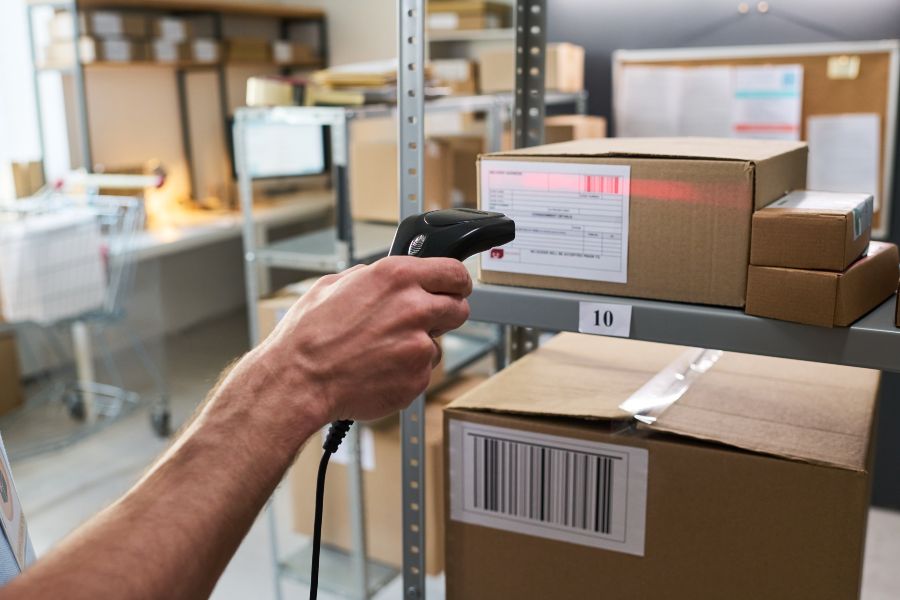
An RF scanner, short for radio frequency scanner, is a handheld or wearable device used to read barcodes and wirelessly transmit data to a warehouse management system (WMS), enabling real-time inventory tracking of orders and stock movements across a facility. Understanding how RF scanners work is the first step toward using them to their full potential.
You'll hear them called by a few different names: RF terminal, RF scanner gun, barcode reader, handheld barcode scanner, or mobile computer. They all refer broadly to the same category of device, though their technical capabilities vary. What most RF scanners share is the ability to transmit data wirelessly via radio waves back to a central WMS, which is where the "RF" in the name comes from. The radio frequency refers to how scanned data is transmitted, not the type of tag being read.
Here's how the process works at a basic level:
- A light source (laser beam or LED) illuminates the barcode label on the product or shelf
- The scanner's sensor captures the reflected light and converts it into an analogue signal
- A decoder interprets that signal and converts it into digital data for accurate data capture
- Real-time data transmission sends that data wirelessly to the WMS, which acts on it immediately
In Australian fulfilment centres, RF scanners most commonly scan barcodes in 1D and 2D formats, though select models can also be configured to read RFID tags. The WMS holds a master record of every product in the facility and cross-references each scan against that data, flagging mismatches, confirming picks, and updating inventory control records continuously.
What a 99.9% Accuracy Rate Looks Like in Practice
Our pick-and-pack solutions use AI-powered robotics to eliminate picking errors at the source. Babyboo achieved 77% YoY order growth and 80%+ improvement in same-day fulfilment after switching to our 3PL in Sydney and Melbourne. Contact us today - (02) 9090 4747
Types of RF Scanners Used in Warehousing
Understanding the types of RF scanners available helps you choose the right tool for your operation. Here's a breakdown of the most common categories:
Laser RF Scanners
Laser RF scanners are the most widely used type in warehousing. They use a laser beam to illuminate barcodes, with the sensor reading the reflected light to decode the information. Laser scanners are reliable for scanning items with standard 1D barcodes, offer a scanning range of up to 24 inches, and perform well in demanding warehouse environments. Their main limitation is that laser scanners can only read 1D barcodes and can struggle with damaged barcode labels.
Image Scanners
Image scanners use imaging technology, specifically a small digital camera, to capture a picture of the barcode and decode it. Unlike laser scanners, image scanners can read both 1D and 2D barcodes, including QR codes, handle damaged labels more reliably, and scan barcodes from any angle. Most RF scanners in the image category also have a shorter scanning range of up to 9 inches, but their flexibility makes them a strong choice for operations that need to process data from a wider variety of label types.
Handheld Barcode Readers

Handheld barcode readers are the most common form factor across warehousing and logistics. Handheld scanners are portable, trigger-activated, and allow workers to move freely while scanning items throughout the facility. Handheld barcode scanners are suitable for nearly every warehousing task from receiving and put-away through to picking, packing, and dispatch. They are available in both laser and image variants, depending on the barcode types used in your operation.
Presentation RF Scanners
Presentation RF scanners are stationary devices designed for hands-free scanning at fixed points such as checkout counters or packing stations. Unlike handheld scanners, presentation scanners automatically read barcodes as items are passed in front of them, without requiring manual trigger activation. Presentation scanners are well-suited to high-throughput environments where workers need both hands free to handle items during scanning.
Fixed Mount Scanners
Fixed mount scanners are stationary devices mounted along conveyor belts, production lines, or warehouse entry and exit points. They automatically scan barcodes as items pass by, making them ideal for fully or semi-automated environments where manual scanning would slow operations down.
Mobile Computers
Mobile computers combine the scanning capabilities of handheld barcode readers with the processing power of a portable computer. They run on Android operating systems, support real-time data transmission via Wi-Fi and cellular networks, and allow workers to access data, process data, and manage tasks all from a single device. They are the most powerful category of RF scanning devices available for warehouse operations.
RF Scanners Cost: What to Budget
RF scanners' costs vary widely by type and capability. Basic handheld barcode readers start from around $100 to $500, while mobile computers range from $600 to $1,500 or more. Ruggedised models built for harsh environments can exceed $2,500. When evaluating your chosen RF scanner, factor in the total cost of ownership, including maintenance, training, and integration with your existing warehouse management system.
RF Scanning vs. RFID: Understanding the Difference
Both technologies use radio frequency to transmit data, but they work quite differently. RFID, or radio frequency identification, uses radio waves to communicate with electronic tags that don't require a direct line of sight, whereas RF scanning relies on a direct line of sight to read a printed barcode label.
RF Scanning vs. RFID at a Glance
Asset tracking, access control, supply chain
For most Australian fulfilment operations, barcode-based RF scanning remains the more practical and cost-effective backbone of warehouse operations. That said, integrating RF scanners with RFID readers as part of a broader multi-technology setup can further enhance operational efficiency across the facility.
Why Picking Errors Are So Costly in High-Volume Fulfilment Centres
The Hidden Price Tag on Every Mispick
A mispick is never just a mispick. In a high-volume fulfilment centre, a single picking error sets off a chain of costs that extend far beyond the original order. Here's exactly what's at stake:
- Re-picking and re-shipping costs: When a wrong item is dispatched, the correct one must be re-picked, repacked, and reshipped, often at expedited freight rates to meet the original delivery promise. You're essentially paying twice for the same order.
- Returns processing labour: Receiving the wrong item back, inspecting it, restocking it, and reconciling the inventory record consumes significant staff time and warehouse resources on an order that was already a loss.
- Inventory records falling out of sync: Each unresolved mispick introduces inaccuracies into your WMS. Over time, those inaccuracies compound, directing future workers to bins with incorrect stock counts and perpetuating the cycle of errors.
- Customer service costs: Every mispick that reaches a customer generates a complaint to investigate, a service interaction to manage, and often a discount or credit to retain the relationship.
- Customer churn: According to PwC's Future of Customer Experience report, 32% of customers will stop doing business with a brand they love after just one bad experience. A fulfilment error is exactly that kind of experience.
- Scaled annual losses: According to a survey of 300 supply chain and distribution managers, distribution centres are losing an average of nearly $585,000 per year due to mispicks. A peer-reviewed study examining order-picking human factors across 113 warehouse workers confirms that individual factors like fatigue and loss of attention drive errors even in technology-assisted environments, meaning the fix must be structural, not motivational.
RF scanners address this not as a band-aid fix, but as an operational infrastructure change, embedding verification at every step of the pick process to remove the conditions that allow errors to occur in the first place.
8 Ways RF Scanners Reduce Picking Errors in High-Volume Fulfilment Centres
1. Real-Time Barcode Verification at the Point of Pick
The most direct way RF scanners reduce picking errors is through instant barcode verification at the exact moment an item is selected.
When a worker scans a product barcode, the RF scanner communicates with the WMS in real time. The system cross-references the scanned data against the order details and confirms or rejects the pick on the spot. If the wrong item has been scanned, an alert appears on the device screen immediately, before the item goes anywhere near a tote or carton.
This scan-to-verify step replaces manual scanning methods and the "look and hope" approach of paper-based picking with a definitive digital confirmation. There's no ambiguity. Either the item matches the order, or it doesn't, and the worker knows which before they move on.
A 2024 peer-reviewed paper published in the International Journal of Research and Innovation in Social Science found that integrating RF scanners with barcode scanning in warehouse operations can improve inventory accuracy from manual levels of around 63% to as high as 99.9%, and can reduce manual entry errors by up to 30%. For high-volume fulfilment centres where workers are under time pressure, this real-time checkpoint is what keeps accuracy rates high even when speed is the priority.
2. Handheld RF Scanners Guide Workers to the Correct Bin Location

Location errors are one of the most common causes of mispicks. A worker heads to the right aisle but grabs from the wrong shelf, or picks an adjacent SKU because the location looked close enough.
Handheld scanners eliminate this by providing turn-by-turn guidance to the precise storage location. The WMS transmits the specific location code to the scanner, for example, A-09-P410-30, where "A-09" is aisle 9 and "P410-30" is the exact shelf position, and the worker navigates directly there.
The verification doesn't stop at arrival. Before scanning items, the worker is required to scan the barcode attached to the shelf or bin. Only once the scan confirms the correct location does the system allow the item scan to proceed. This double-check creates two sequential barriers against location-based errors, delivering the kind of accurate data capture that manual processes simply can't replicate.
In large fulfilment centres where thousands of SKUs are stored across multiple levels and aisles, this guided approach is what makes picking accuracy at scale achievable. Handheld devices in this role fit naturally into the pick workflow. A worker simply holds the scanner, points at the barcode, and the system does the rest.
3. Instant Quantity Confirmation and Mismatch Alerts
Picking the right item from the right location is only half the equation. Picking the right quantity is just as critical, and just as easy to get wrong under pressure.
After each successful item scan, the WMS prompts the worker to confirm the quantity picked. The required amount is displayed clearly on screen. If the quantity entered doesn't match what's expected, the system flags it immediately and prevents the worker from progressing to the next pick until the discrepancy is resolved.
This real-time quantity check catches the kind of errors that are easy to make in a fast-paced environment: grabbing a two-pack instead of a single unit, picking one item when three were required, or simply miscounting when moving quickly. Research confirms that wrong items and wrong quantities are the two most prevalent categories of picking errors, accounting for approximately 70% of all warehouse picking errors. RF scanning systems that integrate quantity confirmation ensure these errors are caught at the source.
4. Elimination of Paper-Based Pick Lists
More than 50% of warehouses still rely on paper in some part of their operations. In a high-volume fulfilment centre, paper pick lists are a persistent source of manual entry errors. They can be misread, smudged, lost, or acted on out of order. They can become outdated the moment inventory moves or an order is updated, and a worker with an old pick list has no way of knowing.
Integrating RF scanners into the pick process replaces paper entirely. All pick instructions are delivered digitally through the device, sourced directly from the WMS in real time. There's no manual data entry to transcribe from a printed sheet and no risk of acting on stale information.
Live Pick Instructions. Zero Paper. Zero Guesswork.
Our cloud fulfilment platform and order orchestration system replace paper pick lists with real-time, WMS-driven instructions. Boost Lab achieved 5x processing capacity at 50% lower fulfilment cost after making the switch. Contact us today - (02) 9090 4747
5. How RF Scanning Works as a Final Filter Before Packing
Even in well-run operations, errors can slip through to the packing stage. RF scanners serve as the last line of defence, enabling a scan-and-verify check before any carton is sealed.
As workers are scanning items into a tote or shipping carton, the WMS compares the scanned data against the original order in real time. If an item is missing, incorrect, or duplicated, the system alerts the packer before the order is closed out. Nothing leaves the packing station without a confirmed match, which is what makes this step so critical for tracking inventory accuracy all the way to dispatch.
This automated accuracy check is particularly valuable in high-volume environments where packers are working quickly across multiple orders simultaneously. The scanner handles the cross-referencing, and the packer simply responds to what the device tells them.
6. Live Inventory Synchronisation With the Warehouse Management System (WMS)
One of the less visible but critically important ways RF scanners enhance operational efficiency is through continuous, real-time inventory synchronisation with the WMS.
Every scan updates the inventory record instantly. When an item is picked, the WMS immediately reflects that movement. When stock is received, put away, transferred, or returned, each scan triggers an update. The result is a live, accurate picture of what's in the facility, where it is, and how much remains, making inventory management far more reliable than any paper or manual system.
Inventory inaccuracies are a leading cause of mispicks. When a WMS directs a worker to a location based on stale data, such as a bin that's actually empty or a shelf holding the wrong product, the worker either picks the wrong item or returns empty-handed. Both outcomes create errors and delays. This is a core challenge that a well-configured distribution management system is designed to solve by keeping every layer of inventory data, from storage location to stock count, accurate and continuously updated.
7. Worker-Level Accountability Through Scan Data
RF scanners don't just capture what was scanned. They capture who scanned it, when, and where. Every scan is logged in the WMS with a worker identifier, timestamp, and location code, creating a full audit trail for every pick action across every shift.
This allows warehouse managers to access data about error patterns across the operation and address root causes directly. Rather than guessing where errors are originating, managers can analyse scan data to pinpoint specific zones with elevated error rates, times of shift when accuracy dips, or individual workers who may benefit from additional coaching.
Worker-level scan data gives managers the visibility to respond proactively, before error rates escalate. Workers who know their scans are tracked also tend to be more deliberate and careful, creating a culture of accuracy on the floor.
8. Seamless Integration With Multi-Technology Workflows Including RFID Scanning and Voice Picking
RF scanners don't operate in isolation. In modern fulfilment centres, integrating RF scanners with voice picking systems, RFID readers, conveyor belt systems, and goods-to-person automation creates a layered approach to accuracy that no single technology can achieve alone.
Wearable RF scanners allow workers to keep both hands free during repetitive scanning tasks, particularly useful in pick-and-pack operations. Workers using voice picking systems often use an RF scanner as a secondary confirmation step, scanning the item barcode after the voice system directs them to a location. Fixed-mount scanners and stationary devices along conveyor lines automatically scan items in transit, removing the need for manual scanning at high-speed processing points.
Mobile Computers: The Most Advanced RF Scanning Device
Mobile computers run on Android operating systems and can save scanned data offline when connectivity is temporarily unavailable, uploading it to the existing warehouse management system once a connection is re-established. This is particularly valuable in large facilities or harsh environments where wireless coverage may be inconsistent. Most support Wi-Fi, Bluetooth, 3G, 4G, and 5G connectivity, providing flexibility across different facility layouts. Their ability to process data and access data in one device makes them the most capable tool for complex warehouse operations.
Research examining digitisation in warehouse environments found that integrating RFID with a WMS and broader scanning technologies reduced paper-based processes, improved picking accuracy and internal routing, and decreased the risk of human error, demonstrating the compounding benefits of multi-technology integration. The more RF scanning is integrated across the end-to-end workflow, the more checkpoints exist to catch errors before they reach the customer.
Accurate Picks. Same-Day Dispatch. Every Time.
We process 100% of orders within 2 hours with 99% same-day dispatch, backed by same-day delivery services built directly into the fulfilment ecosystem. tbh Skincare scaled to 20x daily order volumes without sacrificing dispatch speed or accuracy. Contact us today - (02) 9090 4747
Fewer Errors, Faster Fulfilment: Choose the Right RF Scanner for Your Operation

Picking errors aren't bad luck. They're a systems problem. And RF scanners are the fix. When RF scanning is integrated end-to-end, operations that once tolerated 1-2% error rates can achieve up to 99.99% accuracy. For a facility shipping 1,500 orders per day, that's the difference between hemorrhaging revenue and recovering hundreds of thousands of dollars annually. The 8 ways covered in this article share a common thread: RF scanners remove ambiguity from the pick process. Workers follow live, verified instructions. Every action is confirmed with a scan. Every record is current.
At SKUTOPIA, our warehouse management solutions are built to help Australian fulfilment operations unlock exactly that level of accuracy. If mispicks are costing you more than you can afford, let's talk. Get in touch with the SKUTOPIA team today.

Fariha Shuvakhana
Fariha Shuvakhana is the Chief Growth Officer at SKUTOPIA, a 3PL fulfilment and shipping platform for fast‑growing eCommerce businesses. Fariha focuses on sustainable, customer‑first growth - aligning go‑to‑market strategy with operational efficiency and partner‑led expansion.