How an Automated Warehouse Can Transform Your eCommerce Operations
Warehouse automation is increasingly adopted by eCommerce merchants looking to compete more effectively. Rising order volumes, shrinking delivery windows, and tightening labour markets are pushing businesses of every size to rethink how their warehouse operations run.
At SKUTOPIA, we work with Australian eCommerce brands every day who are navigating exactly this challenge. Whether you're shipping 500 orders a week or 50,000, this guide covers everything you need to know about warehouse automation from the types of technology involved to real-world costs, ROI, and how to know when it's the right move for your business.
What is Warehouse Automation?
Turning Manual Warehouse Operations Into a Competitive Advantage
Warehouse automation is the process of using technology and software to move, track, and manage inventory with minimal manual effort from the moment stock arrives at your facility through to despatch.
At its core, it replaces slow, error-prone manual processes with consistent, scalable automated systems that run faster and more accurately around the clock. The goal is to streamline operations across every stage of fulfilment and to reduce the reliance on manual labour in repetitive, time-intensive tasks.
There are two distinct pillars to understand.
- Digital automation covers software-driven tools such as a warehouse management system (WMS), automated data capture, RFID tracking, and inventory management systems that replace manual data entry and spreadsheet-based tracking. A warehouse control system (WCS) sits alongside the WMS to coordinate the real-time activities of automated equipment, ensuring that digital instructions and physical control systems integrate seamlessly.
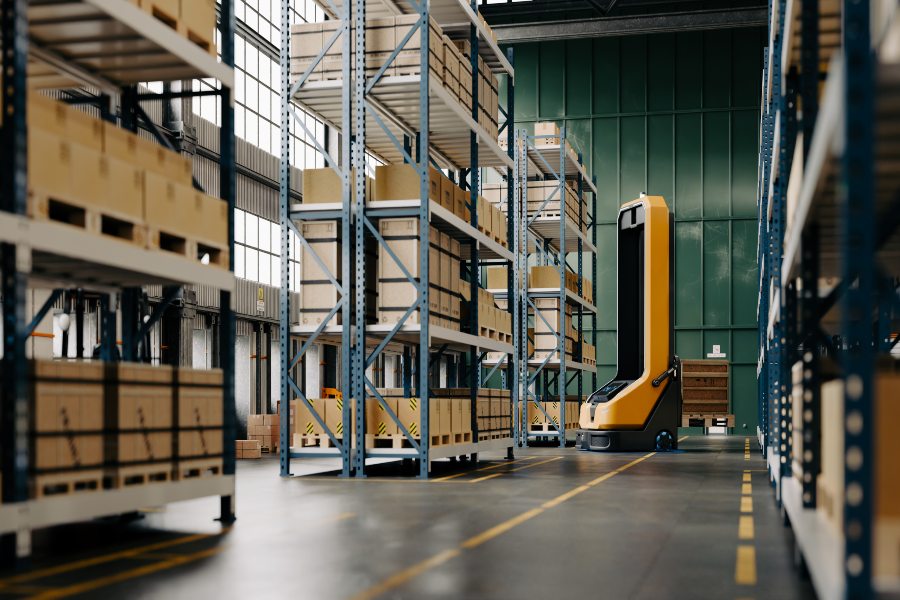
- Physical automation refers to physical automation solutions such as robots, conveyor systems, autonomous mobile robots (AMRs), and automated storage and retrieval systems that handle the physical movement of goods, replacing manual handling at scale.
Importantly, warehouse automation exists on a spectrum. It starts as simply as barcode scanning at your receiving dock and scales all the way to a fully automated warehouse where robotic fleets manage picking, packing, and despatch with near-zero human intervention. For eCommerce merchants, this distinction matters: you don't need a fully automated warehouse to start realising significant gains. Incremental automation even at the digital level meaningfully improves warehouse efficiency, order accuracy, and your team's capacity to handle growth.
Ready to scale your fulfilment?
Our Pick and Pack Solutions use robotic automation to deliver fast, accurate order processing at any volume, with some orders processed on the same day. Fashion brand Babyboo achieved 77% year-on-year order growth and a greater than 80% improvement in orders fulfilled within 24 hours after switching to our AI-powered automated fulfilment. Give us a call today: (02) 9090 4747
Types of Warehouse Automation Technology for eCommerce
Automated Storage, Autonomous Robots, and Automation Technologies That Drive Efficiency
Understanding the types of warehouse automation available helps you match the right solution to your current operational challenges. Here's a breakdown of the core technologies:
Automated Storage and Retrieval Systems (AS/RS)

These are high-density storage solutions designed to maximise vertical space in your warehouse. Rather than workers walking aisles to locate items, AS/RS uses automated equipment including robotic arms, tote shuttles, and mini-loaders to store and retrieve products. These storage and retrieval systems are particularly well-suited to high-SKU eCommerce environments where space is at a premium. According to Element Logic's guide to AS/RS systems, cube-based AS/RS can offer up to 400% more storage within the same warehouse footprint compared to conventional shelving.
Autonomous Mobile Robots (AMRs)
AMRs represent some of the most flexible automation technologies available today. Unlike older automated systems, AMRs use onboard sensors and navigation software to navigate dynamically, adapting in real time to other warehouse workers, equipment, and changing layouts. Some systems also incorporate AI or machine learning, allowing them to refine their routing as the warehouse environment evolves. A 2025 peer-reviewed study published in Transportation Science by Zhen et al. modelled how AMR-assisted order picking can reduce picker walking distance and increase overall warehouse throughput.
Automated Guided Vehicles (AGVs)
AGVs follow predefined routes using magnetic strips or sensors. They're best suited to large, simple warehouse environments with predictable traffic flows, where they can reliably transport goods between storage locations and despatch areas.
Conveyor and Sortation Systems
These systems are the workhorses of high-volume automated warehouses. Conveyor systems move goods through receiving, picking, packing, and shipping stages at speed. Automated sortation systems use barcode scanners, sensors, and RFID to sort items by destination or order criteria essential for distribution centre operations handling thousands of daily shipments. These automated sorting systems also feed real-time inventory data back into the warehouse management system, keeping stock records accurate without manual counts.
Goods-to-Person (GTP) Robotic Picking
This inverts the traditional pick-walk model by bringing goods directly to the picker, rather than sending workers into the warehouse. Manual order picking can consume up to 50% of working hours in travel time alone. GTP systems eliminate most of that waste and can double or triple picking speed. GTP is the foundation of an advanced warehouse automation setup, enabling efficient warehouse operations at volumes that would overwhelm any manual workforce.
Pick-to-Light and Voice Picking
These are human-assisted accuracy tools that guide warehouse employees to the correct designated storage locations using light displays or audio prompts. They improve both speed and inventory accuracy in environments where full robotic automation isn't yet feasible. These tools are an entry point into inventory automation that delivers immediate, measurable gains with minimal disruption.
Automated Packaging Systems
These systems are an increasingly common addition to the modern automated warehouse system. Automated packaging solutions use algorithms to select the optimal packaging format for each order based on product dimensions and fragility, reducing material waste and shipping costs. When these systems integrate with your WMS and sortation infrastructure, the result is an end-to-end automated warehouse system that handles goods from inbound receiving all the way through to labelled, ready-to-ship packages.
For a deeper look at how robotic technology is applied in practice, see our guide on automated warehouse robots. If you're ready to explore what a robotic order fulfilment solution could look like for your business, SKUTOPIA's platform is built to scale with you from day one.
Key Benefits of Warehouse Automation for eCommerce Merchants
Why More Online Retailers Are Automating Their Fulfilment Operations
Automation doesn't just cut costs; it gives eCommerce merchants the ability to scale without proportionally scaling headcount. Here are the benefits that matter most:
- Faster picking and throughput: GTP systems can double or triple picking speed compared to traditional pick-walk methods. Automated warehouses can also operate continuously across extended hours - a meaningful advantage during peak periods, though rated capacity, maintenance schedules, and planned downtime still apply.
- Dramatically improved order accuracy: Automated systems reduce opportunities for the human error that plagues manual processes - miscounts, mispicks, and mislabelling that drive customer complaints and returns. Cangshan Cutlery, after replacing paper-based processes with barcode scanning and real-time data, reached 98.5% picking accuracy within six months, significantly reducing the errors that had slowed their growth.
- Lower labour costs and significant cost savings: Automated systems can meaningfully reduce labour costs over time, directly lowering the operating costs associated with manual labour, including hiring, onboarding, and retraining. The operational efficiency gains compound quickly: fewer errors mean fewer costly reshipments, and faster throughput means more orders fulfilled per square metre of warehouse footprint.
- Better inventory control: Real-time RFID and IoT sensor tracking can significantly improve stock visibility when data, integrations and processes are reliable. Automated replenishment triggers can help reduce stockouts and excess inventory, preventing both costly stockouts and the equally expensive problem of overstocking.
- Improved warehouse efficiency and space utilisation: Automated storage systems make far better use of vertical space and warehouse space than manual racking. AS/RS in particular helps merchants expand storage capacity without moving to a larger facility, a critical advantage in high-property-cost urban locations. Inventory accuracy also improves dramatically, since every movement is logged automatically rather than tracked manually.
- Safer working conditions: Automation can reduce worker exposure to some lifting, repetitive-motion and high-reach hazards. However, robotic systems also introduce struck-by, caught-between and other hazards that require dedicated risk assessment, appropriate safeguards, and staff training before deployment.
- Scalability without complexity: During peak periods - holidays, flash sales, new product launches - well-designed automated systems can absorb a significant share of demand spikes, though capacity remains bounded by the system's rated throughput, maintenance windows and downtime provisions.
Ready to Automate? Here's What's Possible
Boost Lab achieved 8x revenue growth, a 50% reduction in fulfilment cost per order, and 5x processing capacity after partnering with us. Our Retail Fulfilment handles B2B despatch to major retail chains without adding complexity, and Order Orchestration automatically routes every order to the right location for the fastest, most cost-effective outcome. Give us a call today: (02) 9090 4747
How Much Does Warehouse Automation Cost?
Understanding the Investment and How to Calculate Your ROI
The honest answer: a full overhaul of your warehouse system can cost millions of dollars. But warehouse automation doesn't have to start there, and for most eCommerce merchants, it shouldn't.
Costs scale directly with the level and type of automation you choose. Basic digital automation a WMS, barcode scanning, and automated data collection has a relatively low entry point compared to deploying a fleet of AMRs or installing full AS/RS infrastructure. The key is calculating your ROI before committing.
Here's a practical framework:
Step 1: Estimate your current annual labour costs, including hiring, turnover, and retraining.
Step 2: Calculate the total cost of ownership - hardware, software, implementation, site preparation, integration, training, ongoing maintenance, planned downtime, upgrades and financing.
Step 3: Estimate annual savings and efficiency gains: faster picking, reduced errors, lower operating costs.
Step 4: Apply the formula:
ROI = (Annual Net Benefit ÷ Initial Investment Cost) × 100
For example, a $2,000,000 investment in warehouse automation that delivers $400,000 in annual net benefit returns a 20% ROI in year one. Note that ROI can improve as systems mature and labour savings compound, but can also deteriorate through maintenance costs, technology obsolescence or shifts in demand - model a range of scenarios rather than assuming a single trajectory.
Don't overlook indirect benefits: improved customer satisfaction, fewer shipping errors, and omnichannel capability improvements all have real dollar value that rarely shows up in first-pass ROI models. When considering downtime costs, note that IoT Analytics estimated unplanned equipment downtime costs at approximately $125,000 per hour as a cross-industry median across 11 sectors including oil and gas, chemicals and metals - this figure is not a warehouse-specific benchmark. The same research also reported that predictive-maintenance accuracy falls below 50% in many current solutions, so treat automation-enabled predictive maintenance as a capability to build toward rather than an immediate guarantee.
If you're just starting out, begin with a WMS and automated data collection. These deliver meaningful returns quickly, and they lay the data foundation that makes physical automation far more effective when you're ready for the next step.
When Does Warehouse Automation Make Sense for Your eCommerce Business?
Signs It's Time to Stop Managing Manually and Start Automating
Automation isn't the right move for every business at every stage, but there are clear signals that the time has come. Ask yourself these questions:
- Are customer orders being delayed because of workforce constraints?
- Is your picking accuracy consistently falling short of your service-level targets?
- Are your inventory counts unreliable or regularly out of date?
- Are you still managing warehouse operations with spreadsheets or legacy software?
- Do you struggle to scale up and down efficiently for peak trading periods?
- Are you running out of warehouse space or using your current space inefficiently?
- Is warehouse labour becoming harder and more expensive to source and retain?
According to a 2026 Mordor Intelligence market report, the global warehouse automation market is expected to grow from USD $29.98 billion in 2025 to USD $65.74 billion by 2031 a CAGR of nearly 14%. Retail and eCommerce held 28.41% of warehouse automation spending in 2025, the largest single end-user segment. Merchants investing in automation now are building operational capabilities that may prove difficult for slower-moving competitors to replicate.
Automation delivers the strongest ROI in businesses that have: high volumes of repetitive tasks (picking, packing, shipping); standardised and well-documented warehouse processes; rapid growth trajectories that outpace manual hiring capacity; and a genuine need for consistent, high-accuracy order fulfilment.
How to Implement Warehouse Automation: A Practical Roadmap
A Step-by-Step Approach to Successful Warehouse Automation Without the Headaches
Successful warehouse automation is as much about people and planning as it is about technology. Businesses that rush implementation without the groundwork in place tend to underperform on ROI and face significant disruption. Here's a five-step roadmap:
1. Form an implementation committee
Bring together internal warehouse managers, operations stakeholders, and IT leads. Consider engaging third-party supply chain automation specialists who understand your industry's specific demands. Buy-in at every level of the organisation is essential.
2. Collect and audit your warehouse data
You can't automate what you haven't measured. Before introducing any new automated systems, baseline your current performance: order accuracy rates, pick times, labour costs per order, inventory shrinkage, and space utilisation. This data becomes your benchmark. Key decision KPIs to establish at this stage include: throughput, pick accuracy, inventory accuracy, cycle time, dock-to-stock time, labour hours and cost per order, system uptime and utilisation, rework and returns rate, and SLA attainment.
3. Evaluate and refine your inventory controls
Define clear standard operating procedures (SOPs) for purchasing, receiving, storage, picking, quality control, replenishment, labelling, tracking, and despatch. Set the KPIs you'll use to measure whether new warehouse automation systems are delivering results. Conducting a thorough feasibility study of your existing warehouse layout, infrastructure, and current software will prevent costly integration surprises. Many physical automation solutions - including GTP and AS/RS systems - require specific layouts and ample space, so you should evaluate warehouse design before committing to any hardware purchase.
4. Implement a Warehouse Management System (WMS)
A modern WMS manages your inventory and warehouse work - tracking stock, directing picks and put-aways, and providing the data layer that integrates with physical automation. In more complex environments, a Warehouse Control System (WCS) or Warehouse Execution System (WES) layer sits between the WMS and automated equipment to coordinate real-time machine instructions and execution. Together, these systems give you the visibility and coordination that makes automation work. Without a reliable data foundation, disparate automation technologies operate in silos and returns diminish.
5. Choose the right automation tier for your needs now
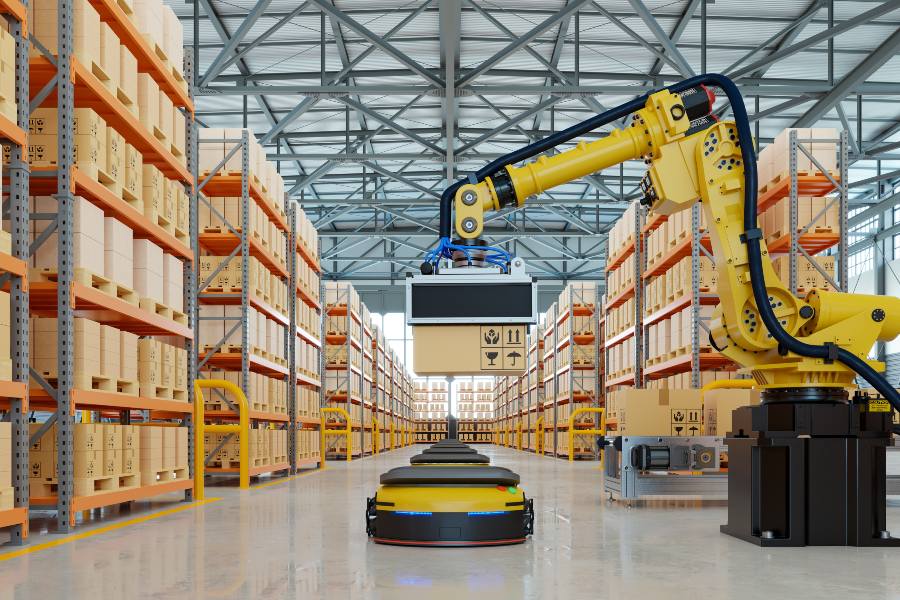
Start by automating key processes where manual labour creates the most friction: receiving, pick-and-pack, and despatch - including returns processing, quality control and labelling where applicable. Use performance data from your WMS to identify where advanced technologies - including robotic picking, AS/RS, conveyor systems, and AMRs - will deliver the most measurable return. Automating key processes in phases allows your warehouse employees to adapt gradually and reduces the disruption that comes with large-scale rollouts. Scale from there as volume and ROI justify the next step.
Best practices to carry through implementation: use a phased rollout (pilot one area before going warehouse-wide), train your team thoroughly at each stage, and maintain open communication so staff understand how automation changes their roles rather than replaces them. According to a 2024 study published in the International Journal of Logistics Management, the most critical factor in successful AMR assimilation in warehouse environments was organisational readiness, not the technology itself.
Cut Costs and Scale Faster With Smarter Fulfilment
tbh Skincare scaled to 1M+ units shipped and a 20x increase in daily orders while cutting fulfilment costs by 50% using our AI-powered robotic fulfilment. Our Cloud Fulfilment model shifts your spend from fixed warehouse overheads to flexible, usage-based costs, and Inventory Forecasting keeps your stock levels sharp, so you're never caught short. Give us a call today: (02) 9090 4747
Smarter Fulfilment Starts Here: The Future of Warehouse Automation in eCommerce
Warehouse automation has moved from a competitive differentiator to an increasingly important capability for merchants at scale - though the right timing and scope will differ by operation. The warehouse automation trends shaping the next few years are already visible today: AI-driven demand forecasting that positions inventory before orders are placed; cobotics (human-robot collaboration) as the standard operational model rather than full replacement; edge computing that enables real-time equipment monitoring and predictive maintenance; and sustainability-focused automated processes that reduce energy consumption and packaging waste.
Advanced warehouse automation is available to a wider range of merchants than before, as technology costs fall and robotics-as-a-service models become more accessible - though suitability still depends on volume, order profile, SKU mix and operational context.
The most successful implementations share a common thread: their automated systems integrate fully with a central WMS and, where needed, WCS or WES layers, so that inventory data, order management, and physical fulfilment workflows all speak the same language. When systems integrate end-to-end, the result is efficient warehouse operations that scale with your business rather than against it.
For eCommerce merchants, the message is simple: automation technologies exist across a wide range of price points and operational scales, and the right entry point depends on your current volume, processes and growth trajectory. Whether your next step is a WMS, a barcode scanning upgrade, or deploying a fleet of autonomous mobile robots, the most important thing is to start with a clear plan, grounded data, and the right partner.

Fariha Shuvakhana
Fariha Shuvakhana is the Chief Growth Officer at SKUTOPIA, a 3PL fulfilment and shipping platform for fast‑growing eCommerce businesses. Fariha focuses on sustainable, customer‑first growth - aligning go‑to‑market strategy with operational efficiency and partner‑led expansion.